
 en
Deformation behavior of complex concentrated body-centered cubic materials: current understanding and open questions
 Professor Jean-Philippe Couzinié
It is our pleasure to invite you to the seminar of IPM CAS, which will take place on Tuesday, September 15, 2026, at 10:00am CEST in the large conference room at the Institute of Physics of Materials, Czech Academy of Sciences. The seminar will be open to the public, and everyone interested is welcome to attend. For those, who cannot attend in person, the online stream of the seminar will be provided via MS TEAMS - please register using this form. Registered participants will receive MS TEAMS link via email shortly before start of the event.
Seminar (in English):
Professor Jean-Philippe Couzinié
Université Paris Est Creteil, Institut de Chimie et Matériaux Paris-Est, Thiais, France
The Ohio State University, Materials Science and Engineering, Columbus, OH, USA
Deformation behavior of complex concentrated body-centered cubic materials: current understanding and open questions
Abstract:
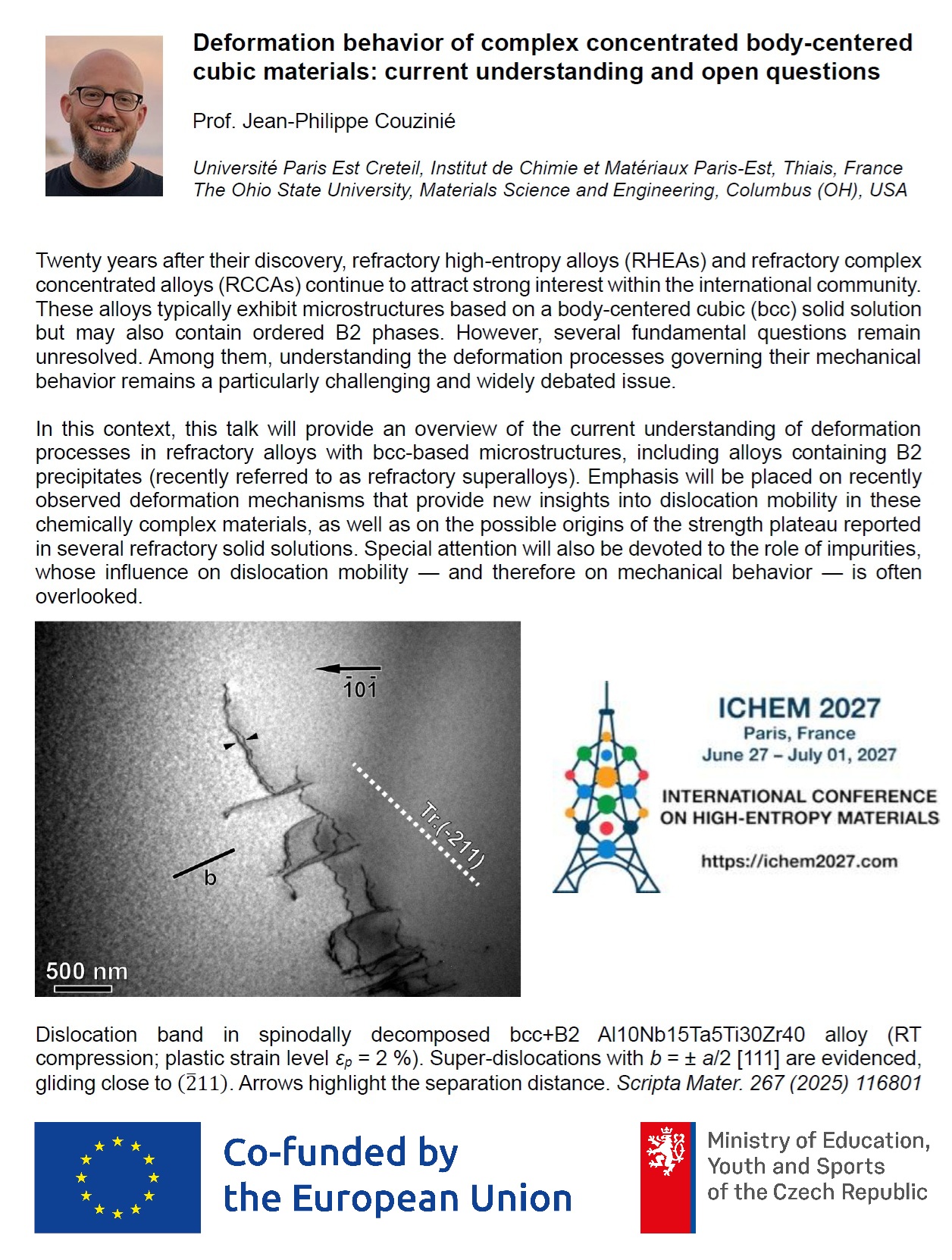
Twenty years after their discovery, refractory high-entropy alloys (RHEAs) and refractory complex concentrated alloys (RCCAs) continue to attract strong interest within the international community. These alloys typically exhibit microstructures based on a body-centered cubic (bcc) solid solution but may also contain ordered B2 phases. However, several fundamental questions remain unresolved. Among them, understanding the deformation processes governing their mechanical behavior remains a particularly challenging and widely debated issue.
In this context, this talk will provide an overview of the current understanding of deformation processes in refractory alloys with bcc-based microstructures, including alloys containing B2 precipitates (recently referred to as refractory superalloys). Emphasis will be placed on recently observed deformation mechanisms that provide new insights into dislocation mobility in these chemically complex materials, as well as on the possible origins of the strength plateau reported in several refractory solid solutions. Special attention will also be devoted to the role of impurities, whose influence on dislocation mobility — and therefore on mechanical behavior — is often overlooked.
This lecture is organized as part of the project “Mechanical Engineering of Biological and Bioinspired Systems (MEBioSys)”, Reg. No. CZ.02.01.01/00/22_008/0004634, co-financed by the European Union.