
 en
en
Programming Metals by Additive Manufacturing: Spatial Control of Microstructure and Mechanical Performance
 Assistant Profesor Efthymios Polatidis
It is our pleasure to invite you to the seminar of IPM CAS, which will take place on Thursday, September 3, 2026, at 10:00am CEST in the large conference room (4th floor). The talk will be given by:
Assistant Profesor Efthymios Polatidis | University of Patras, Greece
The seminar (in English) will be open to the public, and everyone interested is welcome to attend. For those, who cannot attend in person, the online stream of the seminar will be provided via MS TEAMS - please register using the form below, until 9am CEST. Registered participants will receive MS TEAMS link via email.
Abstract
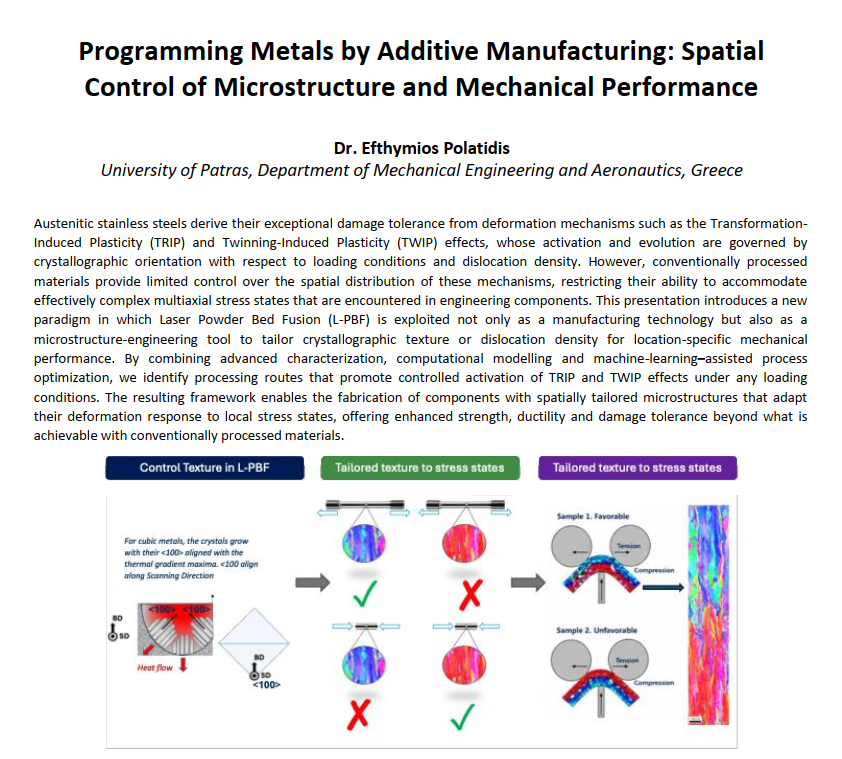
Austenitic stainless steels derive their exceptional damage tolerance from deformation mechanisms such as the TransformationInduced Plasticity (TRIP) and Twinning-Induced Plasticity (TWIP) effects, whose activation and evolution are governed by crystallographic orientation with respect to loading conditions and dislocation density. However, conventionally processed materials provide limited control over the spatial distribution of these mechanisms, restricting their ability to accommodate effectively complex multiaxial stress states that are encountered in engineering components. This presentation introduces a new paradigm in which Laser Powder Bed Fusion (L-PBF) is exploited not only as a manufacturing technology but also as a microstructure-engineering tool to tailor crystallographic texture or dislocation density for location-specific mechanical performance. By combining advanced characterization, computational modelling and machine-learning–assisted process optimization, we identify processing routes that promote controlled activation of TRIP and TWIP effects under any loading conditions. The resulting framework enables the fabrication of components with spatially tailored microstructures that adapt their deformation response to local stress states, offering enhanced strength, ductility and damage tolerance beyond what is achievable with conventionally processed materials.
This lecture is organized as part of the project “Mechanical Engineering of Biological and Bioinspired Systems (MEBioSys)”, Reg. No. CZ.02.01.01/00/22_008/0004634, co-financed by the European Union.